I have published four full-length poetry collections and two pamphlets, as well as many prose books. See those here.
You can buy my poetry books directly from Carcanet or from any bookshop.
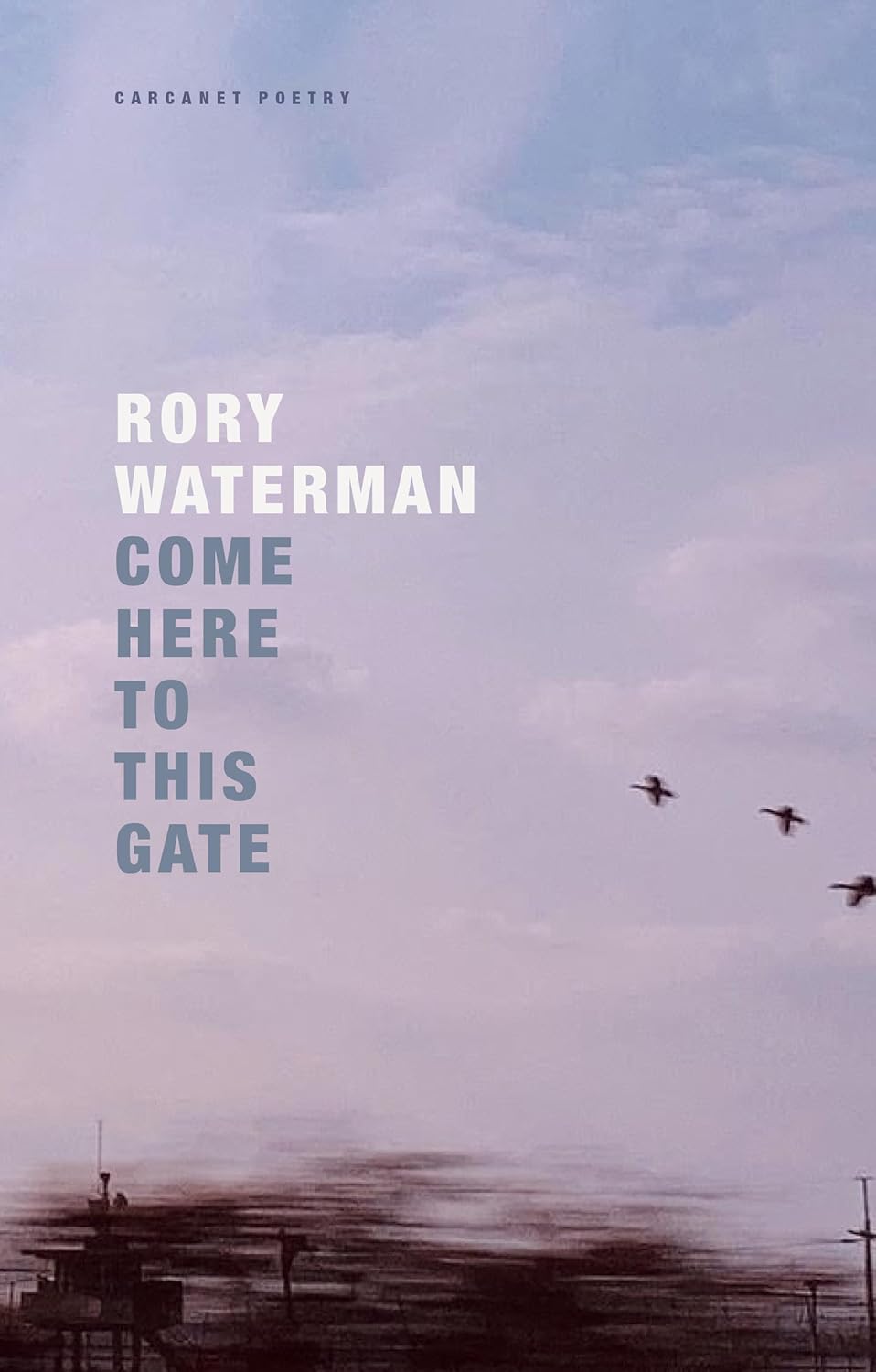
Come Here to This Gate (Carcanet, 2024)
‘A wise and deeply satisfying book.’ – David Wheatley, The Guardian
Come Here to this Gate, Rory Waterman’s fourth collection, is his most candid and unexpected, personal, brash, hilarious, and wide-ranging.
The book is in three parts, the first a sequence about the last year of the life of his father, the poet Andrew Waterman, against a backdrop of recrimination, love and alcoholic dementia: ‘your silences were trains departing’. The second consists of poems that open various gates, or are forcibly restrained behind them, from the literal North and South Korean border to the borders between friends, and those imposed by photographs, memories, and paths taken and not taken. The third opens on the poet’s rural home county of Lincolnshire. He rewrites several folk tales into galloping, sometimes rambunctious ballads for the 2020s: what happens when imps, ghosts, and a boggart who looks like a ‘doll left behind at Chernobyl’ must reckon with the modern world and the people who lumber through it.
‘I have long admired Rory Waterman’s honest, often very sensitive, pitch-perfect poetry. He has the ability to capture, without appearing too knowing, that which is at the edge of the mind. The diverse poems in Come Here to This Gate are enticingly open to both life’s realities and its unrealities. They include acute and moving poems on his father’s dying and on parental separation and its after-effects. This is surely his most deeply resonant and versatile book.’
Moniza Alvi, endorsement on book
‘Rueful, tender and utterly scarifying. […] Waterman is the most Hardyesque of modern poets, forever sniffing out the might-have-beens beneath mere actuality. […] A wise and deeply satisfying book.’
David Wheatley, The Guardian
‘Combines candour, anger, kindness and humour, and doesn’t stint on any. […] It could all be bleak and exhausting but isn’t, the pep of the language and visual fizz ensuring otherwise.’
Vona Groarke, The Irish Times
‘It is these poems’ formal control and wit that ultimately make them so moving.’
Stephen Knight, The Literary Review
‘Poets often write about grief, but rarely so well about its complexity. […] Moving but never sentimental.’
Graeme Richardson, The Sunday Times
‘All of life is here – the heartache and the humour – bound together by an understanding of the essential fluidity of time and place.’
Isabelle Thompson, The Friday Poem
‘It is always a surprise when a poet writes this honestly. […] A rare degree of concision and control. […] For Waterman, the poet isn’t a priest, prophet or mystic, but part of the same community as the reader, talking and negotiating with them, troubled by the same questions and sceptical of ever finding any easy answers.’
Jeremy Wikeley, Poetry Birmingham
‘Despite its darker side the collection as a whole is thoroughly enjoyable.’
Stephen Cloughton, The High Window
‘It’s perhaps unusual to sit and read a collection of poems from start to finish, although there is an overall shape to this book that rewarded us for approaching it this way. […] As his admirers will know already, Waterman is highly-accomplished in his technicality, but he demonstrates here that he is a sensitive and honest poet too, with a firm grasp on the narrative of his own feelings – and those of others – as well as forming descriptions that will live in the memory. This is a collection that will suit many moods. It is both engrossing and a statement of real talent.’
Colin Tucker, LeftLion
‘The “Folk Tales” come bounding in like comic relief, the weighty air of the principal drama chased off by the spirit of the Greek satyr, or by his distant descendant, the Lincoln Imp, blown out through the “Devil’s Arse” and come to make mischief in the world of airports and tennis clubs and the Cathedral gift-shop. The metrical pulse of these four pieces […] complete a seasonal affective cycle that begins in wintry abeyance and ends in the green livery and dancing energy of spring.’
Stuart Walton, Hong Kong Review of Books
‘Waterman’s great art is knowing what to share, as well as how to share it. […] Eliot celebrated Marvell’s verse for ‘an alliance of levity and seriousness (by which the seriousness is intensified)’ as characteristic of his wit. There’s something similar to be said for what Waterman’s verse now achieves. The poems are never tragic nor sentimental, and the text rarely dwells. Rather, its wit and lightness of touch belies an often bleak subject matter. But the poems are an art in suspension and always leave us thinking – of opportunity, oversight, regret, and loss – and then thinking some more.’
Keith MacDonald, Writing Privacy
‘I urge you to get hold of what is an excellent book that deserves all the praise it has garnered so far. I think it should also win prizes.’
Mat Riches, Wear the Fox Hat blog
‘A beautiful collection.’
Jon Wilkins, Everybody’s Reviewing
‘Deeply Affective. […] Waterman’s poems call us back to read again, promising new openings.’
Yusef Sayed, Lincolnshire Life
Sweet Nothings (Carcanet, 2020)
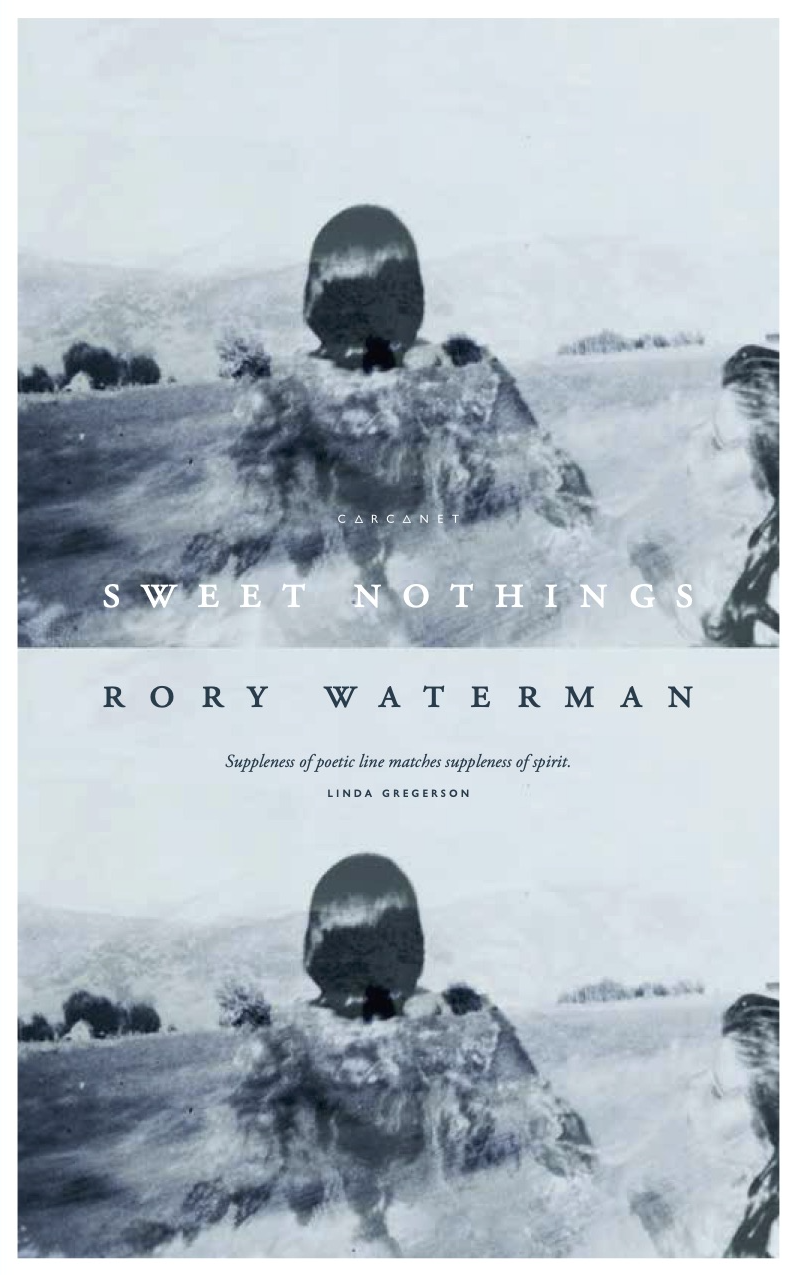
My third collection.
‘Very good indeed.’
Wendy Cope, i
‘Rory Waterman’s excellent third collection’.
Carol Rumens, The Guardian
‘This ingenious collection […]. Themes of sensual gratification, difficult artistry and the interplay of deception involved in both, are ones which Waterman returns to again and again in Sweet Nothings. […] Fine and clear-sighted.’
Andrew Neilson, The Hopkins Review
‘Sweet Nothings’ last poem, in short, fresh lines, urges, ‘Never stop listening.’ I shall certainly listen to new work by Rory Waterman.’
Alison Brackenbury, Poetry London
‘Rory Waterman’s three collections […] demonstrate the progressive strengthening and broadening of his writing (a development without renunciation of previous work) alongside the absorbing of influences into a method and approach that are unique in contemporary UK poetry.’
Matthew Stewart, Wild Court
‘It is clear from the skilful, humorous and frank way in which he considers the conflicts within and between people, Waterman is not on to nothing.’
Yusef Sayed, Lincolnshire Life
‘In many variations of mood, from personal memories of intense anguish to wry observations on the absurdities of contemporary life, Waterman is somehow able to make the move with only the slightest turn of his dial. The fine tuning is extraordinary.’
Gregory Woods
Sarajevo Roses (Carcanet, 2017)
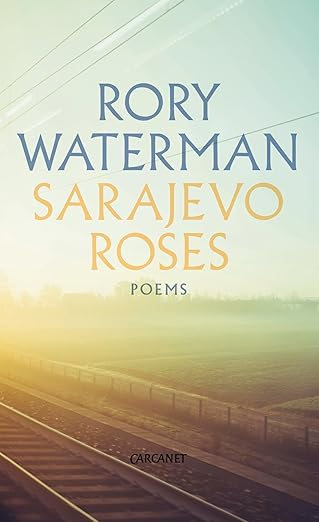
My second book of poems. Shortlisted for the Ledbury Forte Prize for second collections 2019.
‘Very few poets can bring to the lives of others the same devout attention we tend to bestow upon ourselves: Rory Waterman is just such a poet. Whether their site of meditation is an abandoned colliery or a much-marketed urban vista, the exquisite lyrics of Sarajevo Roses are imbued with mindfulness. Suppleness of poetic line matches suppleness of spirit.’
Linda Gregerson, Ledbury Forte Prize judge, 2019
‘His vision is clear, his language scrupulously chosen, his quest for meaning apparent and authentic. […] The world is a slightly better place for the existence of this book. I do not write that lightly.’
Peter Pegnall, Ploughshares
‘Deep imaginative sympathy not just for the victims of history, but for our everyday experiences of family and community. […] Waterman has a flawless gift for the telling detail which says more than pages of polemic. […] Humane and wonderful poems.’
William Bedford, The High Window
‘A seriousness of form and subject uncommon among his generation. […] Subversive – and substantial.’
Robert Selby, The Times Literary Supplement
‘Very affecting […]. The collection moves restlessly through the UK to Europe and the US, and although many specific locations are contained in the titles, and are acutely observed so that we feel we know the place, they quickly become the backdrop to a diorama where the focus turns sharply to some of the big issues in life – relationships, family, procreation, death.’
Vicki Husband, The Compass
‘Although he is sometimes angry, the poet is also generous and open-minded. If, in time, I’m ever asked by anyone what England was like at this time of transition and perceived crisis, I’ll put this book in their hand.’
David Clarke, A Thing for Poetry
Mastery of form here, and tonal control. […] Waterman’s work extends out and beyond any dangerously neat equations or notions of ‘home’ and ‘self’; with him it is in the settings of Europe’s past and future. ‘Brexit Day on the Balmoral Estate’ and ‘Pulling Over to Inspect a Pillbox with a North American Tourist’ (with the “markered slogan”: do bother to find it) are great things. […] Overwhelmingly, entire poems and moments from them prove Waterman to have a fine ear and eye.
Under the Radar
‘A volume that finely balances both wit and wisdom.’
The North
‘For all his often regular metrics and traditional craft, these are not conservative poems; their panic and despair are more in line with Robinson Jeffers than the tweedy members of the Movement.’
Declan Ryan, Poetry London
Tonight the Summer’s Over (Carcanet, 2013)
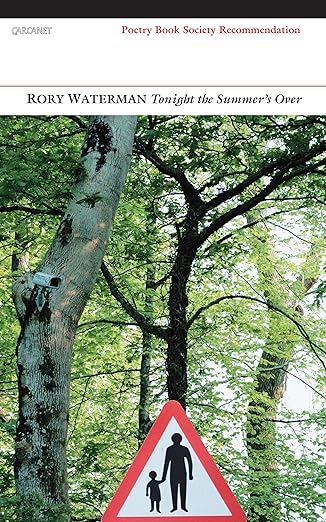
My debut collection of poetry. PBS Recommendation. Shortlisted for the Seamus Heaney Prize 2014.
‘Waterman […] is at once restrained and assured. He has a fine eye for a poem’s architecture, playing with symmetry, taking pleasure in the shape of the page, and he demonstrates a remarkably good ear.’
John Greening, The Warwick Review
‘Great poetry, but poetry to be read with a health warning.’
Belinda Cooke, Stride
‘The best first collection I’ve read in the past couple of years.’
Matthew Stewart, Rogue Strands
‘A convincing, affecting collection.’
Tony Roberts, Stand
‘The surprise, the drama, is beautifully managed. […] Another perfect little lyric. […] In the final [lines of the collection] description gives way to invocation, to a discreet affirmation of the propriety of a poet’s absorptions, one for whose worth the collection as a whole stands guarantor.’
John Lucas, The Dark Horse
‘A remarkable debut. […] Possessed of some hefty qualities that nimbly span the twin senses of contemporaneity and tradition.’
Martin Malone, The Interpreter’s House
‘There is real skill here.’
Katherine Angel, Poetry Review
‘A hymn to the importance of dusting down and moving on. […] A moving book.’
Ben Wilkinson, The Times Literary Supplement
‘By just picking his words with an almost scientific exactitude he makes a poem that is meditative and unforced.’
The Irish Examiner
‘Rory Waterman writes poems of the kind there’ll always be a need for – poems that require skill to make but don’t insist on it, that combine keen-eyed observation and immediately graspable shades of feeling in a memorable way. Waterman’s is a very appealing voice, laconic, unillusioned and vulnerable. His world is a recognisable and convincing one, his rueful, sometimes harsh sincerity is palpable, and he deserves to be read by anyone to whom these things still matter.’ Alan Jenkins
Two poems from the book are discussed by Henry King here.
‘Access Visit’, which was Guardian Poem of the Week in January 2015; read by Kevin Desmond Swords here.
Brexit Day on the Balmoral Estate (Rack Press, 2017)
A pamphlet of 12 pages. It has sold out, but a few copies are still available directly from me. Please email via the ‘Contact’ tab if you’d like one.
‘Rory Waterman’s first complete collection, Tonight the Summer’s Over was much lauded, seen as ‘the best first collection for the past couple of years’ and was a PBS recommendation. The splendidly titled Brexit Day on the Balmoral Estate is a fine widening out of subject matter.’ Manchester Review
‘[Waterman] confronts the unpoetic Brexit head-on — and then does what poetry does best: writes slant. None of these nine poems is directly about the current political debate; it’s only with the date at the end of the final poem (which is also the title poem) that the pamphlet reveals the pain in its heart. Italicised: 24 June 2016. Yes: that date. So what looked like separate poems, poems about individual places, people, travel — Sarajevo, Palma, Basilicata, Venice, avoiding politics in the pre-election USA — suddenly click into place […]. No, the pamphlet isn’t going to force its opinions on us.’ Sphinx
‘Perfect expression and tone. […]. The poems display clarity and craft and bring us the sense of their occasions strongly without fuss.’ London Grip
NB There is also this, no. 11 in the Clutag Press ‘Five Poems’ series.

